Showing posts with label Books. Show all posts

Sunday, 9 August 2020

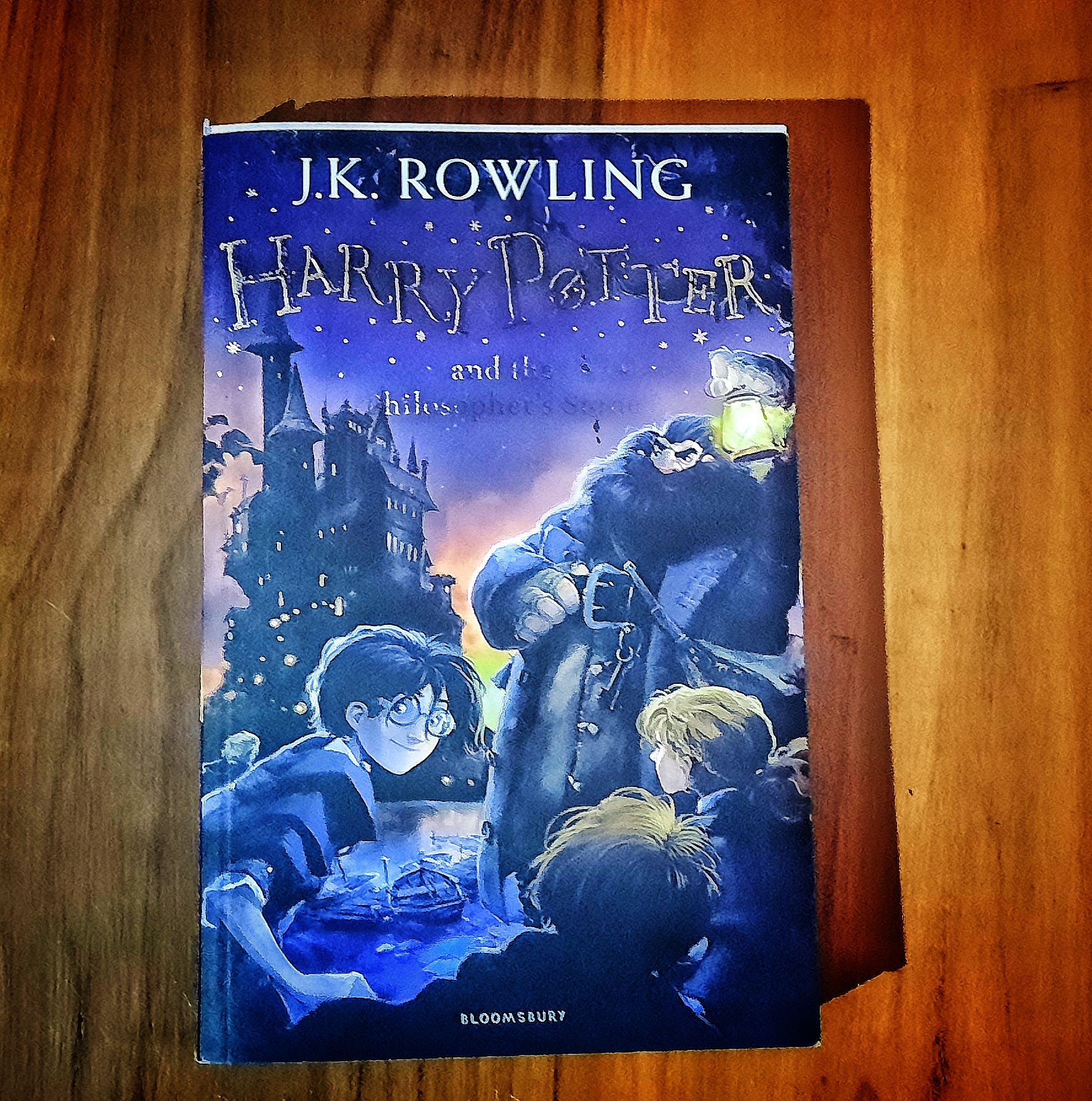
Harry Potter and the Philosopher's stone. A book review.


Harry Potter and the philosopher’s stone is about a young boy living with his aunt, uncle, and their bully of a son as his parents were killed by a car accident when he was just a baby, or so he was told by his aunt and uncle. The Dursleys (his uncle and aunt) did not provide him with any sort of joy or comfort growing up, he spends most time sleeping in a spider ridden cupboard and was given everything their son Dudley broke or had enough of. Further, Harry was frowned upon on everything he did and the strange thing keeps happening around him like the disappearance of the glass frame that prevented the boa constrictor from slithering out in their visit to the zoo did not help either. But fortunately for him, things took a wizardly turn, as he was invited to have his wizard education in the biggest wizard school in existence. He went on to learn how wizards over thousands of years shielded themselves from being noticed by muggles (ordinary and non-magic people like his uncle Vernon and his family) and how his parents were killed by fighting the biggest lord of dark magic, Voldemort for protecting him and about the eventual defeat and disappearance of the said dark lord, Voldemort by him when he was just a baby for which he is famous all over the wizardry world. With his new-found knowledge, he now begins his journey, having a tremendous potential for magic which he was born with and the humility that he attained by living with the Dursleys.


What do I think?

This is the very first book in the infamous Harry Potter series which instantly shot through the roof among the English speaking world at its release in 1995 and over subsequent years, also the near-perfect adaptation into a movie in 2001 made the phenomena unavoidable irrespective of the boundaries of the language. The real-life story of the Joanne Rowling leading up to writing this book is as motivational as the story that the book unveils of the boy, unloved making his way to his destiny in a world filled with magic and hardship using his heart and compassion.


‘’ I had failed on an epic scale. An exceptionally short-lived marriage had imploded, and I was jobless, a lone parent, and as poor as it is possible to be in modern Britain, without being homeless. The fears that my parents had for me, and that I had had for myself, had both come to pass, and by every usual standard, I was the biggest failure I knew.” 

-         J. K. Rowling (in her Harvard commencement speech)


She added,


“……..failure meant a stripping away of the inessential. I stopped pretending to myself that I was anything other than what I was, and began to direct all my energy into finishing the only work that mattered to me. Had I really succeeded at anything else, I might never have found the determination to succeed in the one arena I believed I truly belonged. I was set free, because my greatest fear had been realised, and I was still alive, and I still had a daughter whom I adored, and I had an old typewriter and a big idea. And so rock bottom became the solid foundation on which I rebuilt my life.”


 However great the following books might be of Potter, this one had a truly great story both in and out of the page in the binding, of both its protagonist and of the author who wrote him.


             Worldbuilding is one of the important aspects of the fantasy genre and Rowling’s concept of students going to a school to learn magic is pretty novel and a cool concept. Treading the path of perceiving wizardry as light-hearted and amusing rather than sinister and veil as seen in many literary works and through most, the human culture is well appreciated and since then many tried to emulate.


[   Note :

Joanne Rowling, better known by her initials J K, does not have a middle name, according to her birth certificate. The use of the author's initials instead of her full name was a marketing ploy designed to make her work acceptable to boys, who actively choose not to read books by women.]


Forming spells and enchantments out of classical language such as Latin made them sound more dense and authentic rather than using gibberish for the spells (Thanks to her French and classical degree from the University of Exeter). Hermione Granger is the most entertaining character at least within these books as with her missy too good attitude and her prowess in the spells to back it up but flawed in the social skill as she became cringey and flat-out annoying at some times. Her arc from being a teacher’s pet with no real friends, also being most fixated on rules to breaking rules for friendship is my favorite part of the book. What is more impressive is that while doing all that she did not take away the spotlight from ‘Harry” who was still present as the Hero and was interesting in his own right.


[   Note:

Hermione Granger was Based on Rowling own self from her school days, as the author remembers herself as a book wormy little daughter of Anne, a science technician in the Chemistry department at Wyedean Comprehensive, where she herself went to school and Peter, an aircraft engineer at the Rolls Royce factory in Bristol.]


Bottom-line: 

“Harry Potter and the Philosopher’s stone” is an easily digestible read, with an immaculate world of magic ready to be explored, having the relatable backdrop of school life. 


              Works Cited

Rowling, J.K. “Text of J.k.Rowling’s speech.”  The Harvard gazette.  https://news.harvard.edu/gazette/story/2008/06/text-of-j-k-rowling-speech/ . Retrieved August 09, 2020.  

Savil, Richard. “Harry Potter and the mystery JK’s lost initial.” 

The Telegraph July 19, 2000.  https://www.telegraph.co.uk/news/uknews/1349288/Harry-Potter-and-the-mystery-of-J-Ks-lost-initial.html . Retrieved August 09, 2020.

“About J.K. Rowling.”  Jkrowlinghttps://www.jkrowling.com/about/ . Retrieved August 09, 2020. 


Share:

Tuesday, 23 June 2020

East of Eden by john Steinbeck - a book review

Book 1
East of Eden by John Steinbeck


If one would ask me what was the story of East of Eden? I would quote Steinbeck himself of his answer to another question in this book, which is: what is the story of the world?
“I believe that there is one story in the world, only one, that has frightened and inspired us, so that we live in pearl white serial of continuing thoughts and wonder, Humans are caught -in their lives, in their thoughts, in their hungers and ambitions, in their avarice and cruelty, and in their kindness and generosity too -in a net of good and evil. I think this is the only story we have and it occurs in all levels of feelings and intelligence. Virtue and vice are warp and woof of our first consciousness, and they will be the fabric of our last, and this despite any changes we may impose on the field and river and mountain, on economy and manners. There is no other story. A man, after he brushed of the dust and chips of his life will have left only the hard, clean questions: Was it good or was it evil? Have I done well -or ill? “
This answer cannot be wrong in the case of any story, but especially in this case.  In regards to the story of Trasks, and Hamiltons and the people of Salinas valley and the chink it cannot be any more right. Then the following question would be: if the story is about good and evil, whose story is it? The short answer would be Adam Trask or Caleb Trask(like the James dean’s movie). But that would be just skimming the surface of the pages. Most people (rather than the characters) had a beginning and an end in the story. Cyrus Trask, Charles Trask, Cathy Trask, Samuel Hamilton, Lisa Hamilton, Will Hamilton, Tom Hamilton, Dessie Hamilton, Lee, Aaron Trask, Abra bacon, Mr. Edwards and even Joe valery wasn’t merely spectators, they had their own arcs with ends and beginnings. 
Another reason for perceiving the book being the story of more than two persons is the beautiful descriptive nature of Steinbeck’s writing. He with his words feeds the readers with much of the characters' appearances, mannerisms, and even the secrets. Reading the lines and passages about the characters makes you suspect that he created characters, made them people and then told their story and not the other way around.
 
Cain and Able
Story of Cain and Able from Genesis 4 of the bible is the biggest influence in the book. It was such a major part that there was a separate chapter dedicated to retell the story and then to understand it. Later Lee put forth a new meaning to it, when he roots the original version of the verse from the Hebrew bible from which the subsequent versions replaced (allegedly) the word “thou mayest” with “thou shalt”. Thereby Lee, through him Steinbeck shared the idea that the men have not a promise but a choice to triumph over evil. This idea of choice or not having one crippled Charles Trask to be his own man but always trying to win his father’s affection whereas, at the end, the acknowledgment of the same idea by Adam made Caleb a free man. The novel also blames favoritism as a serious blunder capable of serious harm even if unintended first through Cyrus and then with Adam. 
Another example that shows how the Cain-Able story sink deep into East of Eden is the presence of the Atronyms with the initials “C” (Charles, Cyrus, Cathy and Caleb) and “A” (Adam, Aaron) that Steinbeck implied to clearly differentiate the scent of evil and goodness in its bearer to his readers.
The title “East of Eden” which is the Land of Nod from Genesis 4:16 where Cain was exiled to, as the punishment for his crime puts Salinas valley into metaphysical scrutiny. Not only did the biblical city share structural similarities but also had similarities in its content, which are its people. Steinbeck took great care in writing the character in such a way that they were not creatures of all good or all evil. Even Cathy with whom he personified evil as she allured young boys to give in to the pleasure of the skin, coerced her bible loving teacher to towards sexual desire, burned her parents alive, shot her husband, abandoned her new borne twin-children, poisoned an old lady who loved her like a daughter and endowed her whore house and lied and stole and cheated and whored all along the way have shown a tint of love or affection towards her son Aron before her eventual suicide. 

And through Cathy's demise, he expressed that only an empty and hollow end awaits the ones who lead a life of evil. At the same time stressing the existence of choice against evil within every man and the path of good through which a man can live even after his physical self turn to dust by being in the memories and in the shared goodness of the people he have left.

Conclusion
East of Eden is a microcosm of everything a man might experience in his life. It can be seen as scripture with imperfect people and as a manner book. As it was intended to be that, written by Steinbeck for his sons as a moral paradigm (as Barbara A. heavilin would put it).  

Reference –
Stienbeck, John. East of Eden penguin edition
Holy bible (kjv) – Henderson bibles
Heavilin, Barbara A. East of Eden as a Moral Paradigm

Share: